Twilight Zone

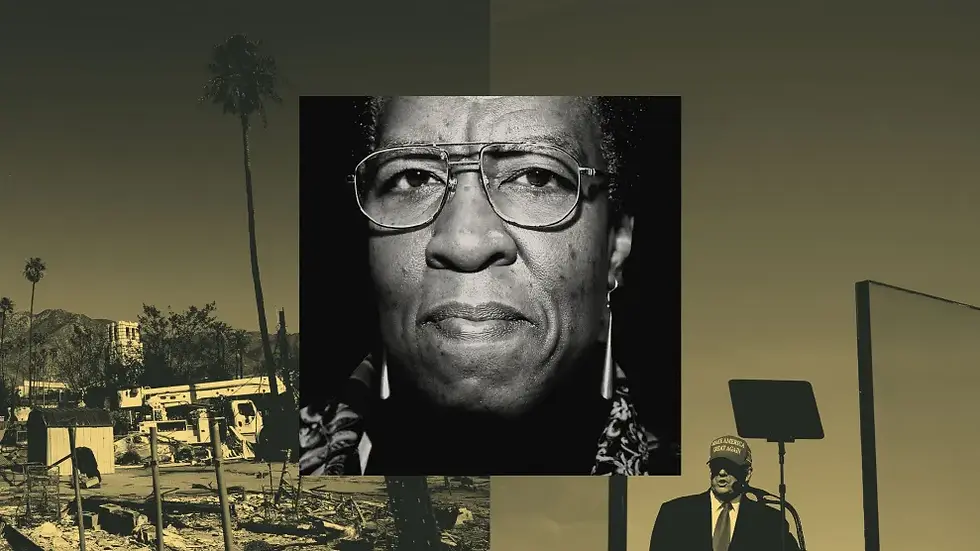
What happens when dystopian visions of futuristic societies stop feeling like fiction and begin to resemble reality?
A year ago, a group of us read Octavia Butler’s Parable of the Sower & Parable of the Talents (read my blog3/1/25). What struck me then and disturbs me even more now was how eerily familiar Butler’s imagined America felt. Her novel depicts a society destabilized by economic inequality, climate catastrophe, political fragmentation, corporate power, religious extremism, and the gradual collapse of the institutions people once assumed would protect them. At the time, we could call it dystopian fiction. Today, people can increasingly imagine its possibility. And in some places we are living her novel in real time!
At the same time, there has been growing conversation about the political writings of Curtis Yarvin and their influence within certain sectors of the technology and political worlds. “Curtis Yarvin, the political writer and theorist whose neo-reactionary ideas challenge democratic governance and advocate a radically more centralized form of executive power.” His ideas have gained renewed attention as technology, venture capital, cryptocurrency, artificial intelligence, and enormous concentrations of private wealth have become increasingly intertwined with political power.
That raises an unsettling possibility: Butler may help us imagine what a fractured society looks like, while Yarvin helps us interrogate one ideological pathway by which democratic institutions might be deliberately dismantled or radically restructured creating Butler’s world. His work has constructed an alternate reality that is playing out in real time for many.
One gives us a warning from the margins. The other offers a theory emerging from within a particular center of technological and economic power.
And therein lies the irony.
Curtis Yarvin will probably never be read by the majority of Americans. Neither will Octavia Butler. Their audiences occupy very different intellectual and cultural spaces. Yarvin's work has circulated particularly within technology, venture-capital, libertarian, and predominantly White male political subcultures. Butler has developed an especially powerful readership among Black readers, women, feminists, spiritual thinkers, Afrofuturists, environmentalists, and people interested in communities surviving systems that have failed them. And yes, I may have missed a few communities in between for both.
These are not absolute categories, of course. But the distinction raises a more important question:
Will these communities ever read each other?
Will the people fascinated by technological power read Butler closely enough to recognize what happens when power becomes detached from community?
Will those reading Butler as prophecy, warning, or survival literature examine the political philosophies influencing the people who increasingly control technology, capital, information, and infrastructure?
Because if we remain intellectually segregated, one community may be designing the future while another is preparing to survive it.
That should disturb us.
Perhaps that is the prophetic dimension of dystopian literature. Prophecy does not necessarily mean predicting precisely what will happen. In the biblical tradition, prophecy often means revealing where a society is headed if it continues along its present trajectory. The prophet sees what others refuse to see and asks: If we keep living this way, where will this road take us?
That brings us to the political question confronting the United States.
If technological oligarchy, concentrated wealth, and increasingly authoritarian theories of government represent one extreme, will democratic socialism, stronger regulation, economic redistribution, and expanded public institutions emerge as the counterweight? Will American politics increasingly become a struggle between competing extremes because the political center is no longer capable of addressing the depth of the crisis?
Perhaps.
But we should be careful here. Extremism does not automatically create balance. Two opposing extremes can just as easily tear a society apart. Democracy depends on something more difficult than simply placing an equal weight on the opposite side of the scale. It requires citizens capable of recognizing that freedom carries obligations to people beyond themselves.
And this may be where Butler's warning becomes most important.
The fundamental crisis may not finally be technological.
It may not be cryptocurrency.
It may not be artificial intelligence.
It may not even be capitalism, socialism, Democrats, Republicans, billionaires, or government.
Those may simply be manifestations of something deeper.
We stopped caring.
We stopped asking whether our economic systems nurture human beings.
We stopped asking whether technological innovation strengthens communities or merely enriches its owners.
We stopped asking whether leadership serves people or simply accumulates power.
We stopped asking what happens to the poor, the elderly, children, workers, immigrants, marginalized communities, and those without access to the technologies increasingly determining their futures.
And perhaps most dangerously, we stopped asking whether my freedom means anything if achieving it requires your dispossession.
This is where dystopian literature becomes more than literature. It becomes a mirror.
Butler forces us to confront what happens when community collapses and people must rediscover their interdependence in order to survive. Yarvin forces us to confront a very different question: what happens when people become so dissatisfied with democracy that concentrated power begins to look more efficient, rational, or desirable than the difficult work of democratic life?
Put those questions beside each other and the warning becomes difficult to ignore.
The future is not simply something that happens to us.
Someone is always imagining it. Someone is financing it. Someone is building it. And someone will have to live in it.
The question is whether the people building the future and the people who will inherit its consequences are actually talking and listening to learn from one another.
Maybe our greatest political challenge is not finding another ideology powerful enough to defeat the ideology we fear.
Maybe it is recovering the capacity to care enough about one another that no ideology, technology, corporation, billionaire, political party, or government is permitted to decide that some human beings are expendable for the sake of somebody else's vision of progress.
If dystopia is becoming reality, perhaps our first act of resistance is deceptively simple:
Care again. How do we do this together to learn?


Comments